what year did the statue of liberty come to new york
Overview + History
The Statue of Liberty
She is an icon, a national treasure, and i of the most recognizable figures in the earth. Each year millions who cherish her ideals make the journey to experience her history and grandeur in person. She is the Statue of Freedom, a symbol of freedom, inspiration, and hope.
Conceptualizing Liberty
It was 1865 when Frenchman Édouard de Laboulaye proposed the idea of presenting a monumental gift from the people of France to the people of the Us. A n arden t s uppor t er of America , Laboulaye wished to commemorate the centennial of the Declaration of Independence likewise as gloat the close human relationship between France and America. He was every bit moved by the recent abolitionism of slavery in the U.S., which furthered America's ideals of freedom and freedom.
Sculptor Frédéric-Auguste Bartholdi was in attendance for Laboulaye's annunciation. Of like heed with Laboulaye's crusade, Bartholdi began conceptualizing the colossal structure that would shortly be known equally Liberty Enlightening the Earth.
Bartholdi'south pattern encompassed much symbolism: her crown representing low-cal with its spikes evoking sun rays extending out to the earth; the tablet, inscribed with July 4, 1776 in Roman numerals, noting American independence; to symbolize the end of slavery, Bartholdi placed a broken shackle and chains at the Statue'south foot.
Funding the Dream
Fundraising and bringing people together accept always been integral to Lady Liberty's history. It began with efforts to finance this unprecedented undertaking. French republic would be responsible for creating the Statue and assembling it in the United States while the American people would fund and build the pedestal.
To raise funds in France, public fees, various forms of entertainment, and a lottery were used. In the U.S., to finance the pedestal, benefit theatrical events, art exhibitions, auctions, and prizefights were held. Poet Emma Lazarus wrote her famous sonnet The New Colossus in 1883 for an art and literary auction.
Despite these efforts, fundraising for the pedestal went slowly. To spark public action, in 1885, Joseph Pulitzer placed an ad in his paper the New York World inviting readers to donate to the cause. In exchange, Pulitzer printed each donor's proper noun in the paper. The public rose to the challenge with 120,000 people donating over $100,000 and securing the remaining funds needed for the Statue'south pedestal.
Meanwhile in France, Bartholdi required the assistance of an engineer to address structural issues associated with designing such a colossal copper sculpture. Alexandre Gustave Eiffel, just prior to creating his famed Tower, was engaged to pattern the massive iron pylon and secondary skeletal framework that allows the Statue's copper pare to motility independently nonetheless stand up upright.
Construction of the Statue was completed in French republic in July 1884. The massive sculpture stood tall above the rooftops of Paris awaiting her voyage across the body of water.
Back in America that same year architect Richard Morris Hunt was selected to design the Statue's granite pedestal, and structure got underway.
Crossing the Atlantic
For its trans-Atlantic voyage aboard the frigate Isère, the Statue was reduced to 350 individual pieces and packed in 214 crates. The ship arrived in New York Harbor on June 17, 1885. While awaiting construction of its pedestal, the Statue remained in pieces on what was and then called Bedloe's Isle. The pedestal was completed in Apr 1886 and finally, on October 28, 1886, President Grover Cleveland oversaw the dedication of the Statue of Liberty in front of thousands of spectators.
The story of the Statue of Liberty and her island has been one of change. For centuries the island was a major source of nutrient for the Lenape native people and later Dutch settlers. In 1807, the U.S. Army deemed the island a military post, amalgam an 11-point fort to protect New York Harbor. Later on renamed Fort Wood, the structure now serves equally the base for the Statue'due south pedestal. The Statue's own meaning and relevance have evolved with time, as well. Peradventure most notable is the association with welcoming "huddled masses." In 1903, a plaque baring "The New Colossus" was placed in the pedestal. With that Lady Freedom'south significance grew every bit an inspiration to immigrants who sailed passed her on their way to America.
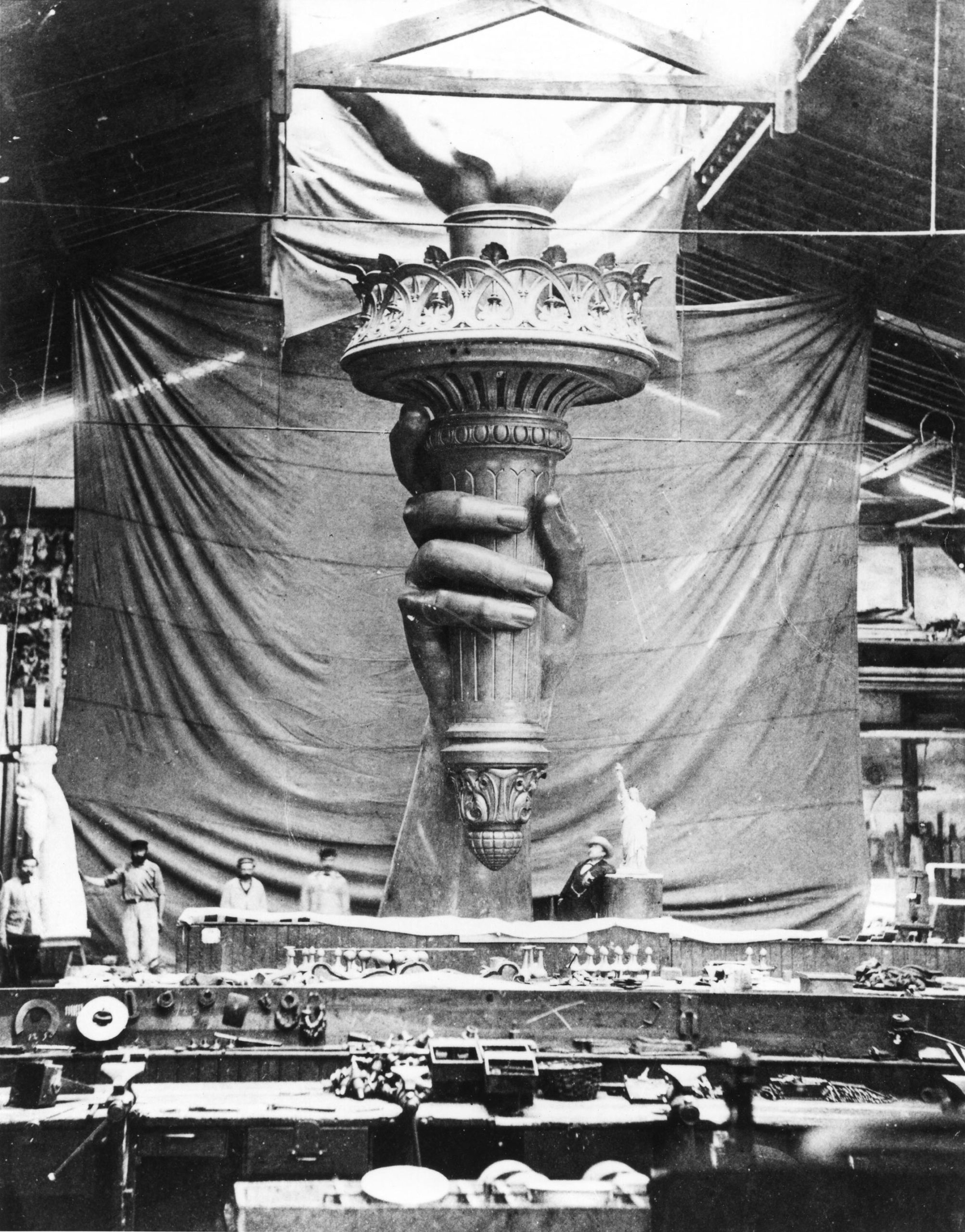
The Statue of Liberty'south Original Torch
As Bartholdi envisioned it in 1874, the flame of the Statue's torch was non to be lighted but rather fabricated of solid copper sail and golden to shine brightly in daylight. Only in during its first half-century, the torch underwent numerous modifications. When the Statue was dedicated in 1886, two rows of portholes had been cut from the copper at the bottom of the torch to illuminate information technology from inside. Half-dozen years later on, an 18-inch belt of glass replaced the upper row of portholes and an octagonal pyramidal skylight with red, white and yellow glass was installed on top of the flame. Changes continued in 1916 when copper was removed in most 250 places and replaced with amber-colored cathedral glass. In 1931 a new lighting system was installed that called for 2 holes 16 inches in diameter to be cut into the floor of the balcony around the flame through which ii projectors were installed. By this time, Bartholdi's design was barely recognizable.
In the 1980s when the Foundation was restoring the Statue for its centennial commemoration, a team of experts adamant that the original torch could not exist restored. A century of modifications had radically altered Bartholdi's solid copper flame to one mainly of drinking glass. Leaks from rain and corrosion from the elements had damaged the original torch above the handle beyond repair. Information technology was removed on July iv, 1984 and replaced with a replica that followed Bartholdi's pattern.
Today, the original torch is on display in the Inspiration Gallery of the Statue of Liberty Museum.
The Foundation works to preserve the Statue of Liberty, aggrandize educational resources, and spark interest in our national heritage.
Source: https://www.statueofliberty.org/statue-of-liberty/overview-history/
0 Response to "what year did the statue of liberty come to new york"
Post a Comment